
Tag: construction job costing software

  • Bench Alternatives for Construction Companies

    Bench Alternatives for Construction Companies

    Table of Contents

    Last Updated: September 22, 2026

    Why Construction Companies Are Switching From Bench

    Bench alternatives construction solutions address a fundamental mismatch: generic bookkeeping software wasn’t built for the complexities of construction accounting. Construction firms deal with job costing, retainage, progress billing, and equipment depreciation that standard platforms simply don’t handle well.

    Contractors switching away from Bench cite the same recurring problems. The platform treats all businesses the same, which means construction-specific workflows get forced into generic templates. Job costing becomes a workaround instead of a core feature. Retainage tracking requires manual workarounds. Field operations and office accounting never truly sync.

    The real issue isn’t Bench’s quality as a bookkeeping service. It’s that construction businesses need something fundamentally different. A general contractor managing multiple projects simultaneously needs visibility into which jobs are profitable, which are bleeding money, and why. Bench wasn’t designed with that lens.

    When construction companies evaluate bench alternatives, they’re really asking: “Will this platform understand how we actually work?” That’s why specialized construction accounting software and fractional controller services have gained traction. They start from construction workflows, not from generic bookkeeping templates.

    Construction Job Costing Software: Beyond Generic Bookkeeping

    Job costing is where construction accounting diverges most sharply from standard bookkeeping. A job costing system tracks costs by project, phase, or phase component, then compares actual spending against estimates.

    Here’s what that means in practice: You bid a kitchen remodel at $45,000. Your estimate breaks down labor, materials, and overhead by task. As work progresses, every expense gets tagged to that specific job. At any point, you can see whether labor is running over, whether material costs matched your assumptions, and whether the job will hit your margin target.

    Generic bookkeeping platforms like Bench record expenses and generate P&L statements. Construction job costing software goes deeper. It tracks costs against budgets in real time, flags overruns before they become problems, and shows which jobs are actually profitable after all expenses are accounted for.

    This distinction matters because construction margins are thin and project-specific. A contractor might be profitable overall but losing money on specific jobs. Without job costing visibility, that contractor won’t know which projects to avoid or how to price future work more accurately.

    Bench alternatives for construction companies typically embed job costing as a core feature, not an add-on. That’s the key differentiator.

    Bench Alternatives for Construction Companies: Feature Comparison

    Tool Best For Key Strength Mobile Access
    Contractor Foreman Small to mid-sized general contractors All-in-one field operations + accounting integration Yes, field-to-office sync
    Houzz Pro Residential remodelers and home builders Client-facing project management + marketing Yes, visual project planning
    BuildOps Commercial contractors and service firms Dispatching + real-time billing workflows Yes, technician scheduling
    Autodesk Build Large general contractors, complex projects Document control and compliance management Yes, field-based access
    AMG Accounting Construction firms seeking strategic guidance Industry-specialized fractional controller services N/A (consulting-based)

    Contractor Foreman: All-in-One Field-to-Office Management

    Contractor Foreman positions itself as an affordable alternative to enterprise construction management platforms. The tool includes over 35 features: time cards, estimates, daily logs, inspections, and integrated accounting for job costing and expense tracking.

    The field-to-office synchronization is the core value. A crew member logs time and materials on a mobile device. That data flows directly into the accounting system, eliminating manual data entry and reducing the lag between field work and financial reporting.

    Contractor Foreman integrates with QuickBooks Online and Desktop, which matters if you’re already using QuickBooks for general ledger and tax prep.

    The trade-off: the extensive feature set creates a learning curve. New users often need time to understand the workflow and configure it for their specific business. But once configured, the time savings are real.
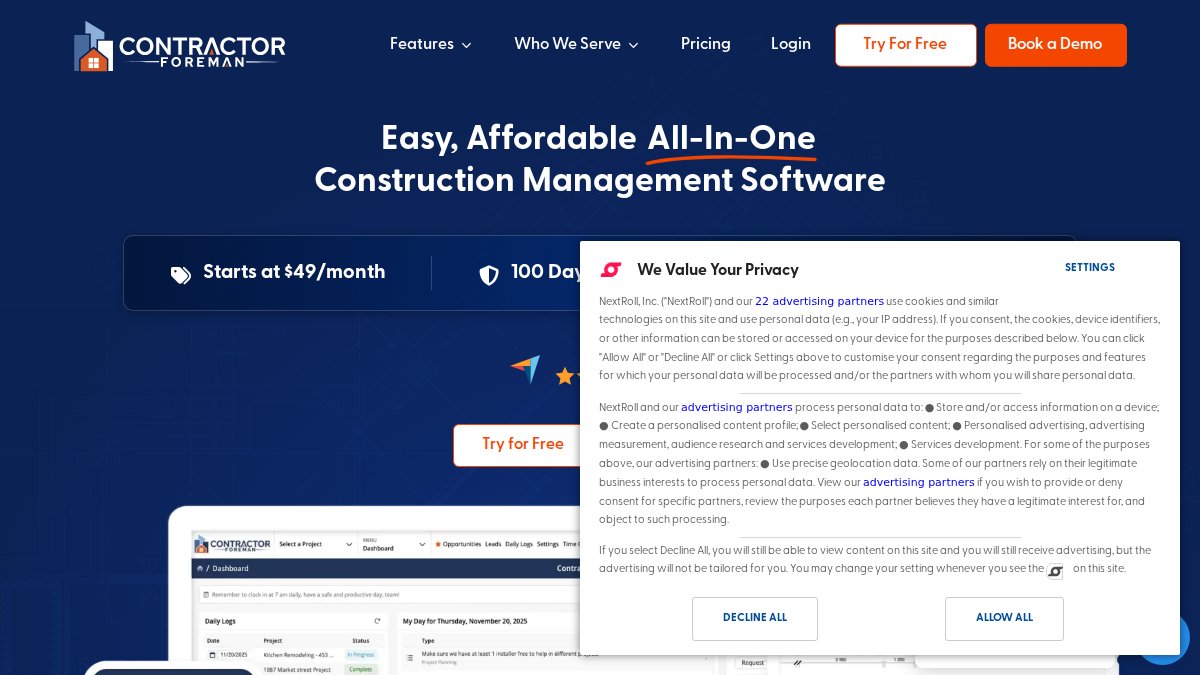
    Screenshot of contractorforeman.com interface
    Contractorforeman website

    Houzz Pro: Residential Construction and Remodeling Focus

    Houzz Pro is purpose-built for residential remodelers and home builders. It combines CRM tools for tracking leads, project management with 3D floor planners and mood boards, financial tools for estimates and invoicing, and integrated marketing services.

    The strength here is client-facing workflow. A remodeler can create visual project plans, share them with clients, and manage the entire customer relationship within one platform. For firms that compete on design and customer experience, this matters.

    The financial tools handle estimates, invoices, and expense tracking, but they’re secondary to the project management and marketing features.

    BuildOps: Commercial Contractor Accounting and Dispatching

    BuildOps specializes in commercial contractors and service-heavy operations. The platform integrates dispatching and scheduling for field technicians with project management and accounting workflows.

    Real-time dispatching is the differentiator. As jobs come in, BuildOps assigns technicians, tracks their location and progress, and automatically generates billing based on completed work. For service-based contracting (HVAC, plumbing, electrical), this workflow is essential.

    Get Started Today →

    The reporting and analytics are strong. You can track job profitability, identify which technicians are most efficient, and see which service types generate the highest margins. That data drives better pricing and resource allocation decisions.
    Screenshot of buildops.com interface
    BuildOps: Commercial Contractor Management Software

    Autodesk Build: Enterprise-Grade Project and Document Control

    Autodesk Build is the enterprise option. It’s designed for large general contractors managing complex, multi-phase projects with extensive document and compliance requirements.

    The platform excels at document management and version control for blueprints, change orders, RFIs, and submittals. Quality and safety management tools help enforce field compliance. Cost management modules track budgets and change orders across projects. Integrating these specialized construction management tools ensures that complex life safety and low voltage requirements remain synchronized with broader project workflows.

    This is overkill for small residential contractors but essential for firms managing $50M+ in annual projects. The complexity and cost reflect that positioning.
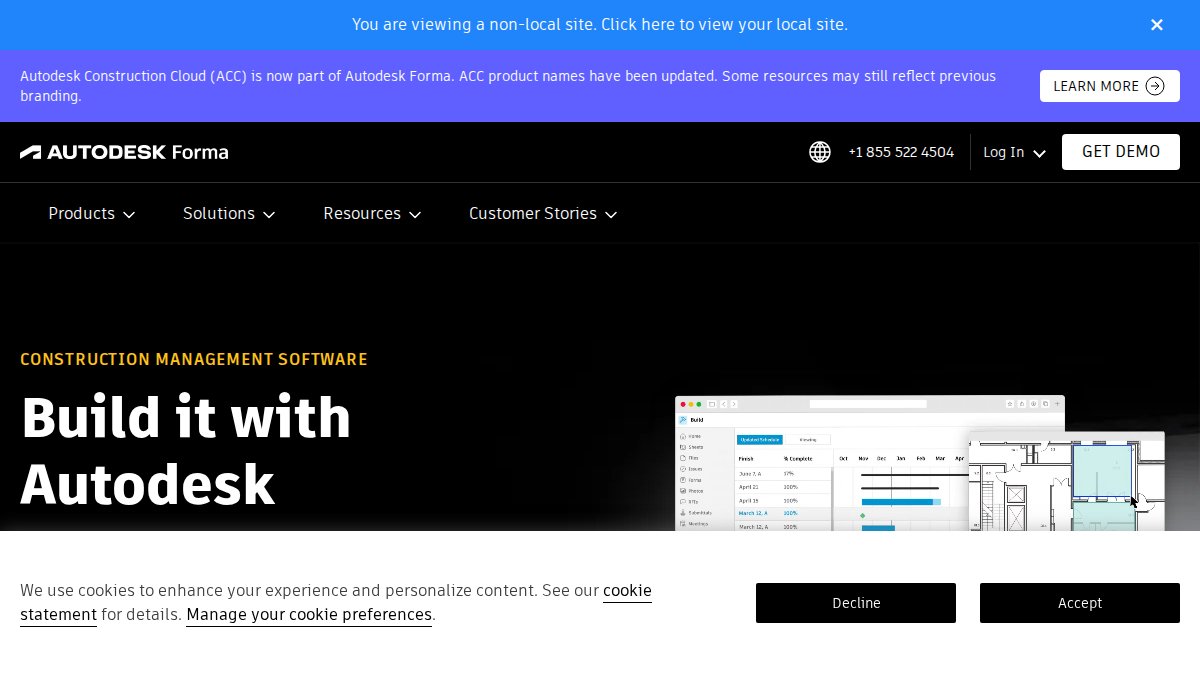
    Screenshot of construction.autodesk.com interface
    Construction Management Software | Autodesk Construction Cloud

    AMG Accounting: Industry-Specialized Fractional Controller Services

    AMG Accounting takes a different approach than software-first solutions. Rather than implementing another platform, construction firms get a fractional controller who understands construction accounting and provides strategic financial guidance.

    This matters because construction bookkeeping and tax prep are only part of the problem. Many contractors struggle with cash flow management, job profitability analysis, and pricing strategy. A fractional controller works alongside your team to answer these questions: Which jobs are actually profitable? Why is cash flow tight despite strong revenue? How should we price future work?

    AMG Accounting handles everything from basic bookkeeping and tax preparation to SOP writing and dashboard creation for KPI tracking.

    Fractional Controller for Construction: When You Need Strategic Financial Guidance

    A fractional controller isn’t a bookkeeper or a tax preparer. It’s a part-time CFO who provides strategic financial guidance without the full-time cost.

    Construction Bookkeeping Best Practices: What Bench Misses

    Bench alternatives construction platforms often emphasize features that standard bookkeeping solutions overlook. Understanding these best practices clarifies what to look for.

    Full-Service Accounting vs. DIY Software: Total Cost of Ownership

    The choice between DIY software and full-service accounting isn’t just about the monthly fee. Total cost of ownership includes your time, the learning curve, and the opportunity cost of not having strategic guidance.

    DIY software (like Bench alternatives that are self-service platforms):

    • You manage data entry, bank reconciliation, and financial reporting
    • Monthly cost is lower ($50-300 depending on the platform)
    • You handle tax prep or pay separately for a CPA
    • Time investment is significant: 10-20 hours per month for most small contractors
    • You won’t get strategic guidance on job profitability or cash flow optimization

    Full-service accounting (like fractional controller services):

    • A professional handles bookkeeping, tax prep, and strategic analysis
    • Monthly cost is higher (varies, but typically $500+ depending on complexity)
    • You get proactive guidance on profitability and cash flow
    • Your time investment drops dramatically: maybe 2-5 hours per month for coordination
    • You gain strategic insights that can improve pricing and project selection

    How to Choose the Right Bench Alternative for Your Construction Business

    Start by defining your specific pain point. Are you struggling with job costing accuracy? Is cash flow management the issue? Do you need field operations integration? The answer shapes which alternative makes sense.

    Construction business owner reviewing financial reports and bench alternatives construction data on a laptop.
    Construction business owner reviewing financial reports and bench alternatives construction data on a laptop.

    Frequently Asked Questions

    What does ‘bench’ mean in construction accounting?

    In construction, ‘bench’ typically refers to unused labor capacity or idle crew members not actively assigned to billable projects. However, when discussing Bench as a software alternative, you’re looking at a general-purpose bookkeeping platform. Bench alternatives for construction are specialized tools that handle job costing, project profitability tracking, retainage accounting, and field-to-office workflows that generic bookkeeping software misses.

    Why should construction companies use specialized accounting instead of general bookkeeping software?

    Construction has unique financial needs: job costing by project, retainage holdbacks, change orders, equipment depreciation, and seasonal cash flow swings. General bookkeeping software treats all revenue as one stream. Construction job costing software tracks profitability per job, identifies cost overruns before they spiral, and handles compliance with prevailing wage and lien laws. Specialized tools also integrate with field operations, reducing manual data entry and improving real-time visibility.

    Is it cheaper to hire a part-time bookkeeper or use a Bench alternative?

    Cost depends on your construction firm’s size and complexity. Full-service alternatives, such as a fractional controller for construction, cost more upfront but eliminate manual data entry, reduce errors, and provide strategic financial guidance. Total cost of ownership favors outsourced services if your time is better spent on sales or operations.

    What construction bookkeeping best practices do I need to implement?

    Key practices include: separate job codes for every project to track profitability; reconcile accounts monthly to catch errors early; track retainage and holdbacks separately to avoid cash flow surprises; categorize expenses by job and cost type for accurate job costing; maintain mobile time tracking for accurate labor allocation; and review financial dashboards weekly to spot cash flow tightness before it becomes critical. Construction bookkeeping best practices also require documenting lien waivers and maintaining compliance records for tax purposes.

    What’s the difference between a fractional controller and a bookkeeper for construction?

    A bookkeeper records transactions and maintains accurate records. A fractional controller for construction does that plus interprets the data, identifies trends, forecasts cash flow, recommends cost-cutting strategies, and guides business decisions. For construction firms managing multiple projects, a fractional controller analyzes job profitability, flags underperforming contracts early, and helps you understand why cash flow is tight despite healthy revenue. This strategic layer transforms accounting from a compliance task into a business intelligence tool.


  • How to Manage Construction Job Costing in 2026

    How to Manage Construction Job Costing in 2026

    Table of Contents

    Last Updated: September 16, 2026

    What You’ll Need Before You Start Tracking Job Costs

    Construction job costing is the practice of tracking every direct and indirect cost tied to a specific project so you can see whether that job actually made money. Many contractors can quote a job accurately but have no idea what it cost them until the project closes.

    Before you track a single cost, gather four things:

    • A job-specific budget broken into cost codes
    • A chart of accounts built for construction, not retail
    • A way to capture field data daily, not monthly
    • A commitment to review estimated vs actual costs weekly

    Step 1: Set Up Cost Codes and a Chart of Accounts for Construction Job Costing

    Cost codes are the backbone of construction job costing. A cost code is a short numeric label that assigns every dollar to a category of work, such as 03-100 Concrete or 26-000 Electrical.

    A practical starting structure:

    • 1000-1999: Direct labor and labor burden
    • 2000-2999: Materials
    • 3000-3999: Equipment and rentals
    • 4000-4999: Subcontractors
    • 5000-5999: Overhead and indirect costs

    Step 2: Separate Direct vs Indirect Costs in Construction

    Watch Out
    Mixing indirect costs into direct job accounts inflates your apparent job profit and hides your true overhead. Contractors who do this often feel profitable while their bank account says otherwise.

    Assign every invoice to either a job or overhead. No exceptions.

    Step 3: Learn How to Calculate Construction Overhead and Allocate It Per Job

    Overhead allocation is where most job costing systems quietly fail. If you cannot put a defensible number on what each job owes the business for indirect costs, your “profitable” jobs are an illusion.

    Start With Labor Burden, Not Just Overhead

    Before allocating company overhead, make sure direct labor carries its own burden. Labor burden is everything you pay on top of base wage: payroll taxes (FICA, FUTA, SUTA), workers’ compensation, general liability tied to payroll, paid time off, and union or benefit contributions. Burden commonly adds 25-40% to base wage, depending on your trade, your state’s workers’ comp rates, and your experience modification rate.

    Calculate Your Overhead Rate

    To calculate construction overhead, total your annual indirect costs, then divide by a consistent allocation base. A simple method:

    1. Add up annual overhead, office rent, insurance not tied to payroll, admin salaries, vehicles, software, utilities, and depreciation on shared equipment.
    2. Choose an allocation base. Direct labor hours and contract revenue are the two most common.
    3. Estimate total annual direct labor hours (or revenue) across all jobs.
    4. Divide overhead by that base to get your overhead rate.
    5. Multiply the rate by each job’s actual base to allocate overhead.

    Choosing an Allocation Base

    • Direct labor hours works best when crews vary widely in size and your work is labor-intensive, tying overhead to the resource that drives supervision, safety, and admin effort.
    • Contract revenue suits firms with steadier project values and heavy material or subcontractor content, where labor hours understate the management burden.
    • Equipment hours is sometimes layered on top for heavy-civil and sitework contractors who carry significant iron.

    Pick one primary base and stay consistent. Switching bases job to job makes year-over-year margin comparison meaningless.

    Over-Absorbed vs Under-Absorbed Overhead

    Your overhead rate is an estimate. At year end, overhead absorbed through jobs rarely equals overhead incurred. The difference is over- or under-absorption.

    • Over-absorbed: you billed more overhead into jobs than you spent. Jobs look slightly less profitable than they were.
    • Under-absorbed: you spent more overhead than jobs absorbed. Your real margins are worse than the job reports show.
    Watch Out
    Allocating overhead only at year end defeats the purpose. By the time you true up, the jobs are closed and the pricing decisions are already made. Allocate monthly so the feedback loop is short enough to change behavior.

    What Most Guides Skip

    Most job costing guides stop at the formula. Overhead allocation only works if your chart of accounts cleanly separates indirect from direct costs, and if your accounting system can post allocated overhead to each job without manual journal entries. If you allocate in a spreadsheet, document the rate, base, and source data, the moment you bid using that rate, it becomes an audit trail.

    Step 4: Track Labor, Materials, and Equipment in Real Time

    Real-time tracking means field data reaches the office the same day it happens. Daily crew logs, material delivery tickets, and equipment hour meters feed your job cost report before week’s end.

    Construction superintendent using a tablet to monitor construction job costing while a crew works on-site
    Construction superintendent using a tablet to monitor construction job costing while a crew works on-site

    Set up three daily habits:

    • Foremen submit hours by cost code before leaving the site.
    • Material receipts get photographed and logged same day.
    • Equipment hours are recorded against the job using them.

    Step 5: Use a Construction Job Costing Spreadsheet Template or Software

    A construction job costing spreadsheet template works for a handful of active jobs. It breaks down past roughly ten concurrent projects, when you need real-time visibility across crews, or when WIP schedules must tie to your financial statements.

    Method Best For Key Limitation
    Spreadsheet template Under 10 active jobs Manual entry, no live sync, no audit trail
    Basic accounting software Small contractors Limited job-level detail, weak WIP reporting
    Dedicated job costing software Growing firms, multiple crews Higher setup time, requires clean cost codes

    When a Spreadsheet Stops Working

    Construction job costing software makes sense when manual updates lag behind the work, change orders get lost, and you cannot answer “what is this job costing me right now” without an hour of digging. The clearest signal: your WIP schedule no longer ties to the general ledger without a day of reconciliation.

    Get Started Today →

    Integrating Job Costing With Accounting and ERP Systems

    Job costing data is only useful if it flows into the same system that produces your financial statements. Otherwise you maintain two sets of numbers and reconcile them by hand.

    What to look for in the integration:

    • Chart of accounts mapping. Every cost code must map to a general ledger account. Different account structures between tools mean re-keying data forever.
    • Two-way sync vs one-way export. One-way export from field app to accounting suits small firms; two-way sync matters when committed costs (purchase orders, subcontracts) must reflect in real time.
    • Committed cost tracking. Job costing is not just what you have spent, it is what you have committed. Purchase orders and subcontracts must hit the job cost report when issued, not when the invoice arrives.
    • Payroll integration. Certified payroll, union rates, and multi-state tax withholding must land in the right cost code without manual intervention.
    • WIP schedule generation. The system should produce a WIP schedule tying to the balance sheet, showing over- and under-billings by job.

    Handling Change Orders and Scope Creep in Your Job Costing Model

    Change orders are where job costing models most often break. A change order is not just a revenue adjustment, it is a new cost code, budget line, and set of committed costs.

    A practical process:

    1. Assign a unique change order number the moment the scope change is identified, before pricing is finalized.
    2. Create a parallel cost code for the change order so its costs do not blend into the original contract.
    3. Track approved vs pending separately. Pending change orders should appear on your WIP schedule as unapproved but probable revenue, with the associated costs already committed.
    4. Update the job budget the day the change order is approved, not at month end.
    5. Re-run the WIP schedule after every material change order to confirm the job is still on track.

    Tax Implications and Audit Readiness

    Job costing data feeds directly into how you report income. Under percentage-of-completion, the IRS expects revenue recognized based on the ratio of costs incurred to total estimated costs. That ratio is only as accurate as your job cost data, miscoded costs or stale estimates mean a wrong tax return.

    Clean job costing also supports:

    • Look-back interest calculations under the completed-contract method, if applicable.
    • Audit defense. When the IRS or a state agency reviews a contractor, the first thing they ask for is the job cost detail behind the return.
    • Surety and bonding capacity. Sureties underwrite based on your ability to produce reliable job cost and WIP reports. Poor job costing directly limits how much work you can bond.
    Pro Tip
    Before buying software, map your current cost codes and approval flow on paper. Software amplifies whatever process you feed it, including a messy one. The integration will not fix a chart of accounts that mixes direct and indirect costs.

    Training Field Staff for Data Entry

    The human element is the most underestimated part of any job costing system. Software does not collect data, foremen do. If the field does not submit accurate hours, quantities, and receipts daily, the best system produces garbage.

    What works in practice:

    • Five-minute daily entry, not a thirty-minute form. Mobile apps with pre-loaded cost codes and photo receipt capture reduce friction.
    • Tie entry to a daily routine. End-of-shift, before the crew leaves the site, not the next morning.
    • Show foremen the output. When crews see how entries affect the job’s margin, accuracy improves.
    • Audit for a month. Spot-check entries against delivery tickets and timecards until the habit sticks.

    Common Mistakes That Blow Up Job Costing (and How to Avoid Them)

    The biggest mistake is treating job costing as a month-end task. By then, the money is spent and the job is nearly done.

    Other frequent problems:

    • Ignoring change orders. Untracked scope creep silently erodes margin. Log every change order with its own cost code.
    • Sloppy subcontractor management. Missing lien waivers and unverified invoices create cost and compliance risk.
    • No overhead allocation. Jobs look profitable until overhead lands.
    • Poor field-to-office communication. Delayed data means delayed decisions.
    • Overlooking tax implications and audit readiness. Clean, consistent records keep you ready for review.

    Conclusion

    Job costing fails quietly, and the loss usually shows up long after the work is finished. AMG Accounting provides bookkeeping built for construction, job costing and WIP tracking, and clear financial reporting that explains your numbers in plain English. Get started with AMG Accounting.

    Frequently Asked Questions

    What are the 7 steps involved in job costing?

    The seven steps are: (1) set up cost codes and a chart of accounts, (2) separate direct from indirect costs, (3) calculate and allocate overhead, (4) track labor, materials, and equipment in real time, (5) compare estimated vs actual costs, (6) handle change orders and update the budget, and (7) review project profitability at closeout. Each step feeds the next, so skipping one usually shows up later as a budget variance you cannot explain.

    What is the difference between direct and indirect construction costs?

    Direct costs are expenses tied to a specific job: materials, crew labor, subcontractors, and equipment rented for that project. Indirect costs, also called overhead, cover expenses that support the whole business, like office rent, insurance, and a supervisor who splits time across jobs. Direct costs go straight to the job’s cost code. Indirect costs get allocated across jobs using a consistent method, usually a percentage of direct labor or revenue.

    Can I use a spreadsheet template instead of construction job costing software?

    Yes, a construction job costing spreadsheet template works well for a small operation with a handful of active jobs. Build columns for cost codes, estimated vs actual costs, and budget variance, and update it weekly. Once you are running more than five or six jobs at once, or field crews need to enter data from the site, a spreadsheet gets messy fast. That is when construction job costing software pays for itself.

    How do I keep job costing accurate when change orders come up?

    Log every change order the day it is approved, not at month-end. Give it its own line under the job’s cost code, update the estimated cost and contract price, and send the client a revised billing. If you wait, your work-in-progress (WIP) schedule and revenue recognition will be off, and you may not notice a job slipping into a loss until it is too late to fix.